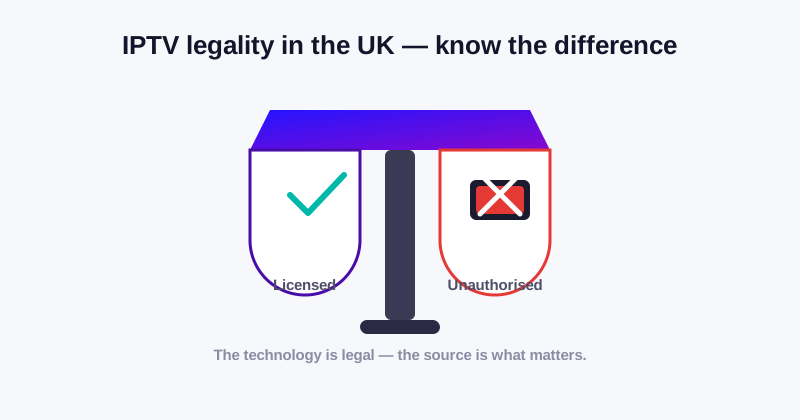
Is IPTV legal in the UK? It is one of the most common questions we hear, and the answer requires a little nuance. The technology behind IPTV is perfectly legal. However, the legality of a specific service depends entirely on where its content comes from and whether the provider has the rights to distribute it.
This guide explains the difference in plain language, what the law says, the real risks of pirate services, and how to tell a legitimate provider from an unauthorised one.
What IPTV actually is
IPTV, or Internet Protocol Television, is simply a way of delivering television over the internet rather than through a traditional broadcast signal. It is not inherently illegal — in fact, you probably already use IPTV-style technology every day. Streaming platforms, catch-up services and even some broadcaster apps all deliver video over the internet.
The technology is a delivery method, not a content source. Whether a service is legal depends on what it streams and whether it has permission to do so.
Legal vs unauthorised IPTV services
The line between legal and illegal IPTV is not about the technology — it is about licensing.
A legal IPTV provider holds the rights to the content it offers, or it only streams material that is freely licensed. These providers operate like any other media business: they publish terms, respect copyright, and respond to takedown requests. They may have a legitimate catalogue of free-to-air channels, licensed on-demand content, or content they have produced in-house.
An unauthorised IPTV service, by contrast, typically redistributes premium channels (sports, cinema, box sets) without the broadcasters' permission. These are often advertised at impossibly low prices and are the source of most "is IPTV legal?" confusion. They are the services that get shut down and that put customers at risk.
What does UK law say?
In the UK, the relevant law is copyright law, most importantly the Copyright, Designs and Patents Act 1988. Streaming, transmitting or facilitating the unauthorised communication of copyrighted works to the public is an infringement. Selling or operating a service that does this can be a criminal offence.
The law has been actively enforced against large pirate IPTV operations. There have been high-profile prosecutions of individuals running illegal streaming services that rebroadcast Premier League football, cinema releases and pay-TV channels. These prosecutions target the operators of the services, and people who sell subscriptions to them.
For the end viewer, the legal position is more nuanced. Simply watching IPTV is generally treated less harshly than operating a service. However, if you subscribe to a service you know is unauthorised, you are still using infringing content, and you expose yourself to the practical risks described below. The safest position is simple: use a provider that is clearly legitimate.
The real risks of using unauthorised IPTV
Beyond the legal question, there are practical downsides to pirate services that people rarely think about.
- No reliability. Unauthorised servers are shut down without warning. Your "lifetime" subscription can vanish overnight, together with all your money.
- No support. If the service breaks, there is no one to contact. There is no refund, no fix, no accountability.
- Malware and scams. Pirate IPTV apps and sites are a common way to distribute malware, phishing links and credential stealers. You are handing your device and data to unknown operators.
- Payment risk. You often pay through unregulated channels, with no protection if the service disappears.
- You fund crime. Pirate IPTV networks are frequently linked to organised crime. Your subscription money can end up funding activity far beyond copyright infringement.
None of these risks apply to a legitimate provider. That is why choosing the right service matters so much.
How to tell if an IPTV provider is legal
It is usually easy to spot a legitimate provider once you know what to look for. Ask these questions before you pay:
Does it have a proper website and company details?
Legitimate providers operate like real businesses. They publish terms of service, a privacy policy, a DMCA notice, and clear contact information. If a service has none of these, treat it as a red flag.
Does it clearly explain what content it is licensed to provide?
A good provider is transparent about its catalogue. It will not pretend to offer premium pay-TV channels it has no right to resell. If a service promises every pay channel on earth for £10 a year, that is a warning sign, not a bargain.
Does it have human, responsive support?
A legal service answers questions, honours refunds where appropriate, and behaves like a business that wants repeat customers. A pirate operation rarely does.
Does it offer a free trial without pressure?
Confident, legitimate providers are happy for you to test the service. A trial is also your chance to check that nothing about the service feels off.
Common myths about IPTV legality
There is a lot of misinformation online about IPTV, so let us clear up the most common myths.
Myth 1: "IPTV is always illegal." False. Many IPTV services are perfectly legal. The technology is neutral; the licensing is what matters.
Myth 2: "If I pay for it, it must be legal." Unfortunately not. Paying for a service does not make it licensed. Some pirate operations charge normal-looking prices, so price alone is not proof of legitimacy.
Myth 3: "Using a VPN makes it legal." No. A VPN protects privacy and solves ISP throttling, but it does not change the copyright status of the content.
Myth 4: "Only the people selling IPTV get in trouble." The primary targets are operators and resellers, but that does not make using an unauthorised service risk-free. You still face security and financial risks, and you are still accessing infringing content.
Myth 5: "All IPTV boxes are illegal." Boxes are just hardware. The problem is only when they are sold with pirate apps or subscriptions pre-installed.
Myth 6: "Free IPTV is always a scam." Free services can be legitimate (for example, free-to-air channels). But many free IPTV apps are distribution channels for malware or copyright infringement. Be extremely careful.
Your responsibility as a viewer
The best way to stay on the right side of the law is to make an informed choice. That means reading the provider's terms, understanding what you are buying, and avoiding anything that looks too good to be true. It also means being honest with yourself: if a service is streaming content it obviously does not own, do not use it.
If you are ever unsure, ask the provider directly. A legitimate provider will be open about what it offers and how it licenses content. An evasive answer is itself the answer.
Does using a VPN affect legality?
A VPN is a privacy tool. It encrypts your connection and hides your IP address, which can stop your internet provider from throttling or blocking streams. A VPN does not make an illegal service legal, and it does not make a legal service illegal. It is simply a tool for privacy and reliability.
If you do use a VPN, choose a reputable one and understand that it is a complement to a legitimate service, not a substitute for one.
Frequently asked questions about IPTV legality in the UK
Is it legal to watch IPTV in the UK?
Watching IPTV is not inherently illegal, but the content and how it is sourced matters. Using a service that redistributes premium content without permission means you are accessing infringing content. The safest route is a legitimate, licensed provider.
Are IPTV boxes legal?
IPTV boxes are just hardware, and they are legal to buy. What matters is the pre-installed apps and the services those apps connect to. If a box is sold with pirate apps or subscriptions, it crosses into illegal territory.
Can I get in trouble for using IPTV?
The authorities primarily target people who operate or sell unauthorised services, not individual viewers. However, using an unauthorised service still carries risks — financial, security and legal. Avoiding pirate services removes the question entirely.
How do I know a provider is licensed?
Check for transparent business practices: published policies, clear contact details, human support, and an honest catalogue. When in doubt, ask. A legitimate provider will gladly explain its setup.
Does IPTV law differ between the UK and other countries?
Yes. Copyright rules vary by country, and enforcement differs. This guide focuses on the UK. If you travel or move, check the local rules where you live.
Can a legitimate IPTV provider stream foreign channels?
Absolutely — if it has the rights to do so. Broadcasting rights are complex and regional, which is exactly why transparency and licensing matter. A provider that is upfront about its catalogue and rights is far easier to trust.
How to protect yourself when choosing IPTV
If you want to enjoy IPTV without worrying about legality, follow this simple checklist.
- Read the terms. A real provider publishes terms of service and a privacy policy. Skim them; they tell you a lot about the operation.
- Look for a DMCA notice. Legitimate services respond to copyright takedowns. The presence of a proper DMCA page is a good sign.
- Test with a trial. A free trial lets you inspect the service before you commit — no risk, and you see exactly what you are getting.
- Pay through traceable methods. Legitimate providers accept cards or recognised crypto. Beware anyone who will only accept untraceable, unrefundable payments.
- Keep an eye on longevity. Providers that have operated for years, with a history of stable service, are less likely to vanish overnight.
- Ask direct questions. Email or message support and ask what content they are licensed to provide. How they answer tells you everything.
The golden rule is simple: if something feels off, walk away. There are plenty of excellent, transparent IPTV services, so there is no reason to settle for one that makes you uncomfortable.
Remember that a legitimate provider wants a long-term customer. It will be happy to explain its service, show it off in a trial, and treat you fairly. That is the standard you should hold any IPTV provider to.
The bottom line
Is IPTV legal in the UK? The technology is. The service you choose determines everything else. If you pick a provider that is transparent, licensed, and accountable, you can enjoy IPTV with none of the legal or practical worries. If you choose a pirate service, you take on real risks that no cheap price justifies.
The smart approach is the same as with anything: do your research, take a free trial, and only pay a provider you trust. That way you get the entertainment you want without the headaches. If you would like to see how a transparent, support-backed IPTV service works, ask us for a free trial — we are happy to answer every question before you decide.