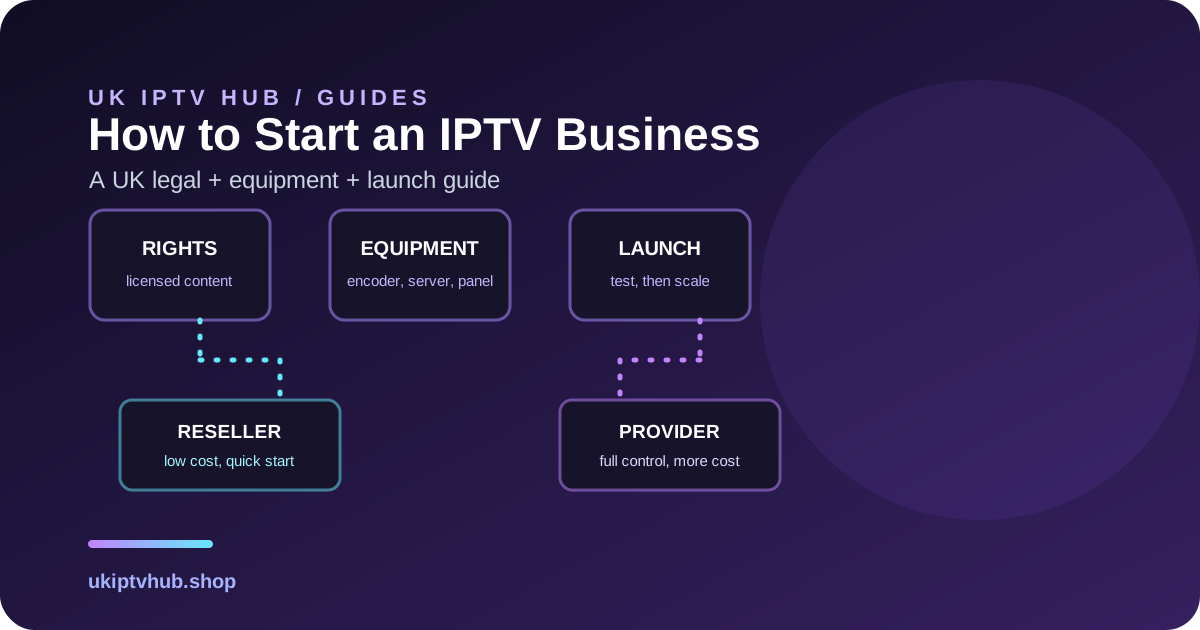
To start an IPTV business in the UK, the single most important step comes before you buy any equipment: make sure the service you sell only carries content the provider is licensed to distribute. Distributing channels or titles without the rights to them is a legal risk under UK law, and that risk sits with you as the operator or reseller as much as with the provider. Once rights are sorted, you choose a model — reselling an existing provider's service or running your own system — gather the equipment, set your pricing, and launch step by step. This guide walks through the full picture so you can start properly, not just quickly.
This guide is informational. It is not legal advice, and it is not a substitute for a qualified lawyer or the official guidance of the relevant bodies. If you are unsure about your legal position, seek professional advice before you begin.
The legal position in the UK: start here
IPTV is not inherently illegal in the UK. What matters is whether the content you distribute is rights-cleared. Broadcasting, streaming or otherwise making available TV channels and films without the rights holder's permission is a copyright infringement, and the law treats the distribution of unauthorised streams seriously. This is true whether you run the service yourself or resell a provider's service: if the provider's catalogue is not licensed, the reseller is exposed too.
So before anything else, establish the rights position of the content you intend to offer. If you are reselling, ask your provider directly whether they hold the rights to the content on their service, and get a clear answer. If you are running your own system, you need to secure the rights to the channels you broadcast — which for major UK broadcasters and premium channels is a commercial licensing exercise, not a formality.
Also be aware that some services advertise 'unlimited' channels at prices that are not plausible for genuinely licensed content. If a deal looks too good to be true, it usually is — and it usually means the content is unlicensed. The UK IPTV Hub reseller guide has more on the checks to run before you commit to a provider.
Choose your business model: reseller vs provider
There are two broad ways to start an IPTV business in the UK, and they are very different in cost, control and effort.
The reseller model
As a reseller, you buy access to an existing provider's service in bulk and resell it to your own customers under your own brand and pricing. You do not build or run the technical platform; you use the provider's panel to create and manage customer lines. This is the lowest-cost way to start, and it is how many small IPTV businesses begin.
The reseller model is attractive because you can start quickly, with very low upfront equipment costs, and you do not need to manage servers, encoders or licensing yourself. The trade-offs are that you depend on the provider's reliability and legal position, and you have less control over the channel list and the technical quality. The reseller-panel guide explains how to choose a provider and panel carefully.
The provider model
As a provider, you run your own system: you license content, encode or ingest channels, run a server or VPS with middleware, and deliver the service to your own customers. This gives you full control and the ability to differentiate, but it is far more expensive and complex. You need the technical skills to run a headend, the rights to the content, and the capital for equipment and bandwidth.
For most people starting out, the reseller model is the pragmatic first step, and the provider model is something to graduate to once you understand the business and have the resources.
The equipment you need: reseller vs provider
The equipment differs sharply between the two models.
Equipment for a reseller
As a reseller, you do not need encoders, servers or middleware. You need:
- A provider and panel. The panel is the dashboard where you create and manage customer lines, set your prices and control connections.
- A way to take payment and manage customers, such as a simple merchant account and a spreadsheet or a small tool.
- Customer support tools, such as a messaging channel and a short setup guide for your customers.
- Your own branding, so you present the service as yours.
Your main 'equipment' investment is time: choosing and testing a provider, learning the panel, and building a small customer base.
Equipment for a provider
As a provider, you need the full technical stack:
- Sources and rights. The channels and titles you are licensed to distribute.
- Encoders. To convert live sources (satellite, cameras, SDI/HDMI) into network-ready streams. The encoder guide explains how to choose them.
- A server or VPS. To run the middleware and deliver streams. The size depends on how many channels and customers you serve.
- Middleware and a panel. The software that organises channels, manages the EPG, handles authentication and gives you a management panel.
- Bandwidth. Enough upstream bandwidth for the streams you deliver to customers.
- Network and edge delivery. For a serious service, a CDN or multiple servers to keep quality high.
This is a real infrastructure project, and it is not a side project you can run from a single laptop at scale.
Realistic costs
Costs vary widely, but it helps to have a realistic mental model.
Reseller costs
A reseller's costs are mainly the wholesale credit they buy from the provider, plus a possible setup or minimum-order fee. Many providers link pricing to the credit you buy in bulk: you buy credit at a discount and resell it at your own margin. There may be no annual fee beyond that, but you should ask for a written price list and check for hidden costs such as minimum orders or credit expiry.
Provider costs
A provider's costs are much higher and include content licensing, encoder hardware (from a few hundred pounds for a small single-channel encoder to several thousand for a multi-channel unit), a server or VPS (monthly), middleware licensing, bandwidth, and ongoing support. Licensing major channels is often the single largest and most awkward cost. Most small providers therefore start small or as resellers, and scale up only once the revenue justifies the platform.
Want to try it yourself? Get a free 1-day trial.
Watch live channels and on-demand titles on your own screen for a day — before you pay a thing. No card details on this site.
Step-by-step: launch as a reseller
If you are starting as a reseller, here is a practical sequence:
1. Research and shortlist providers. Look for providers that can show you their rights position, offer a trial line, and give you a demo of the panel.
2. Test the service. Run a trial line on the device and connection your customers will actually use, including at peak times. Test channel loading, buffering and the EPG.
3. Evaluate the panel. Confirm you can create lines, set your own prices, control connections and top up customers yourself, without waiting on the provider.
4. Check the legal and payment terms. Read the provider's terms on content rights, credit expiry, refunds, and what you are allowed to charge.
5. Set your pricing and brand. Decide your customer price and margin, and prepare your branding and setup guide.
6. Prepare your support. Set up a messaging channel and a short how-to for customers (installing the app, entering the server details).
7. Launch to a small first cohort. Start with a handful of customers, learn what breaks, and fix it before you scale.
8. Grow. Add customers, monitor service quality, and stay honest with customers about what the service can and cannot do.
Step-by-step: launch as a provider
If you are building the full provider model, the sequence is longer:
1. Secure your content rights first. This is non-negotiable and should drive the whole plan.
2. Design the system. Decide the channels, the devices you will support, the middleware, the protocols and the bandwidth.
3. Buy the encoder(s) and server(s) to fit that design — not before. The encoder guide covers choosing encoders that match your middleware.
4. Set up the middleware and the management panel, and configure the EPG.
5. Test end to end on real devices, including load testing for many simultaneous viewers.
6. Launch to a small cohort, monitor quality, and iterate before scaling.
Common mistakes to avoid
The most common mistakes new IPTV businesses make are:
- Skipping the rights check. This is the one error that can sink a business and create legal exposure.
- Chasing 'too good to be true' deals. A service advertising unlimited channels at an implausibly low price almost always signals unlicensed content, which carries legal risk and poor reliability.
- Buying equipment before planning the system. Encoders and servers must match the middleware, devices and network.
- Under-sizing bandwidth. Quality collapses if the network or server cannot carry your streams at peak.
- Choosing a provider on price alone. A cheap, unstable or unlicensed provider destroys your credibility.
- Over-promising to customers. Do not guarantee channels, uptime or anything you cannot deliver. Honest selling protects your reputation.
Frequently asked questions
Is IPTV legal in the UK? Yes, IPTV itself is legal — what matters is whether the content is rights-cleared. Distributing or reselling unlicensed content is a legal risk. Check your provider's rights position and, if in doubt, seek legal advice.
Should I start as a reseller or a provider? For most people starting out, the reseller model is the pragmatic first step because it has very low costs and no infrastructure. The provider model gives more control but requires content licensing, equipment, bandwidth and technical skill, so it suits those who already understand the business.
How much does it cost to start an IPTV business? As a reseller, your main cost is the wholesale credit you buy, plus possible setup or minimum-order fees. As a provider, costs include content licensing, encoders, a server/VPS, middleware and bandwidth, and are substantially higher.
Do I need an encoder to start? Only if you run your own provider system. A reseller does not need encoders, servers or middleware — you use the provider's panel instead. Providers need encoders to convert live sources into streams.
What equipment do I need as a reseller? You need a reputable provider with a panel, a way to take payment and manage customers, customer support tools, and your own branding. Your main investment is time spent testing the provider and learning the panel.